At Greenberg Regenerative Medicine, we honor the traditional treatment methods that have brought relief to countless patients, and we also stay focused on how medical technology evolves so we can keep broadening what we are able to offer. One of the newer developments in the regenerative medicine space is PRP Derma Gel, an evolution of traditional platelet-rich plasma that we are studying for its potential to support the body’s own healing and renewal.
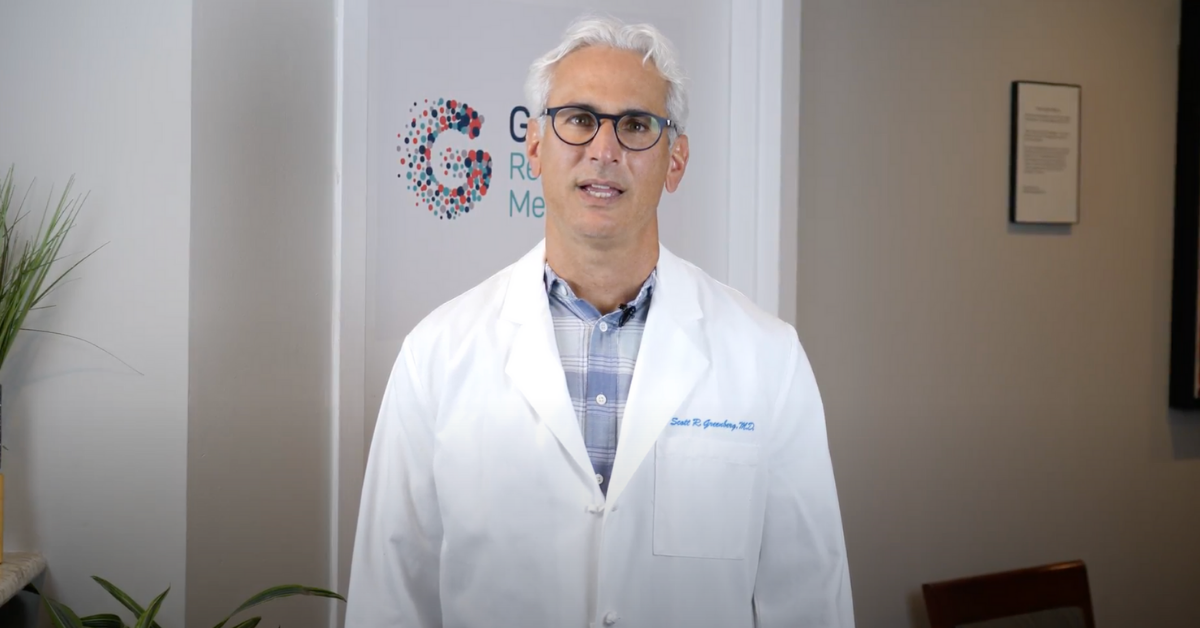
We sat down with Dr. Scott Greenberg to talk about what makes PRP Derma Gel interesting, how he thinks about adopting new approaches, and why GRM keeps exploring even when current treatments are already serving patients well.
Q: What is PRP Derma Gel, and how is it different from the standard PRP you use in your office?
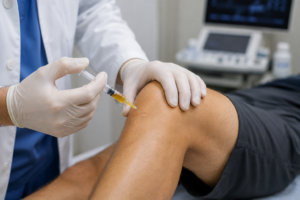
A: “The gel is made from something called PPP, or platelet-poor plasma. We take that plasma through a controlled process of heating and cooling that changes its consistency into a gel that can be used for injection.
Traditional PRP is liquid. PRP Derma Gel has a more cohesive, structured form. That difference in physical consistency is one of the main reasons we find it worth studying.”
Q: Even at this early stage, what do you find most promising about PRP Derma Gel?
A: “What interests me most is that the more concentrated, structured form may help keep the plasma’s own growth factors closer to where they are placed, rather than dispersing as quickly as a liquid can. Its different physical consistency, compared with liquid PRP, is part of what makes it worth exploring. It is early, and we treat it as something we are studying rather than something we are making promises about.”
Q: What can you share about the safety of PRP Derma Gel, especially for patients who feel cautious about newer treatments?
A: “PRP Derma Gel is autologous, which means it is made from the patient’s own blood. Because no outside biological material is introduced, the risk of an allergic reaction or rejection is reduced. Every medical procedure carries some level of risk, and PRP Derma Gel is no exception. That said, using a patient’s own plasma offers a meaningful safety advantage compared with treatments that rely on donor tissue or on unregulated biologic products. There have been reports of serious complications, including infections, from procedures performed outside properly regulated medical settings using donor-derived products. This kind of care belongs in a qualified clinical environment.”
Q: Why keep exploring new approaches when your established methods are already successful?
A: “I think we should always be looking for ways to serve our patients better. It is important not to rest on past success but to keep asking what can be improved. Over the years we have steadily moved toward less invasive techniques whenever the science supported doing so, and that same mindset is how we approach PRP Derma Gel.”
Q: What does being an early adopter of approaches like PRP Derma Gel say about GRM’s philosophy?
A: “It comes down to wanting to provide the best results we responsibly can. My background in aspects of biomedical engineering helps me understand how these systems work, which lets me think carefully about how, and whether, to refine what we do. New is not a reason on its own. Real potential to help patients is.”
At GRM, innovation is approached with both curiosity and caution. New approaches are not adopted simply because they are new, but only when there is a sound scientific rationale and a realistic prospect of improving a patient’s experience, recovery, or quality of life.
Q: How do you decide whether a new regenerative approach is worth introducing into the practice?
A: “It really comes down to understanding the scientific rationale first, and then thinking carefully about how it might apply to real patient care. Every approach we consider starts with research and a clear-eyed look at the evidence.”
The goal is always to balance innovation with thoughtful clinical judgment, so that anything introduced fits the practice’s patient-first philosophy.
Q: Where do you see the potential for PRP Derma Gel?
A: “In aesthetic medicine, we are exploring whether it can help support the skin’s own renewal over time. In regenerative medicine, we are studying whether a more structured form of PRP may be useful for certain musculoskeletal and soft-tissue concerns. As with all PRP, any such use is considered off-label, and it is decided one patient at a time after a thorough evaluation. We are honest with patients that this is an area we are still learning about.”
Looking Ahead
Regenerative medicine is evolving quickly. Approaches like PRP Derma Gel reflect a broader shift toward supporting the body’s own healing rather than only managing symptoms. At GRM, that pursuit continues to guide how we explore new options, always with the patient first and always grounded in honest expectations.
—–
*A note on this treatment: PRP and PRP Derma Gel are prepared from a patient’s own blood and are administered by Dr. Greenberg as part of the practice of medicine. PRP Derma Gel is an emerging approach. It is not approved by the U.S. Food and Drug Administration as a treatment for any specific orthopedic, musculoskeletal, or aesthetic condition, and the statements in this article have not been evaluated by the FDA. Any application is determined individually during consultation. Results vary from person to person, and no particular outcome is promised or guaranteed. This article is for general educational purposes only and is not medical advice. Please consult a qualified physician about your individual situation.*